

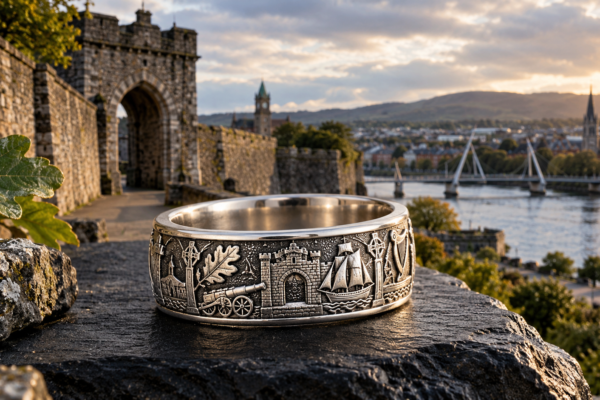
The derry ring is a distinctive piece of commemorative jewellery that brings the history, identity, and cultural heritage of Derry, Northern Ireland, into a wearable form. Rather than serving merely as a decorative accessory, it represents a connection between a historic city and the people who remember it, whether they live locally, have family roots in the region, or have developed an interest in Irish history.
Introduced in 2004 through a collaboration between local jeweller Danny Cooley and historian Michael McGuinness, the History of Derry Ring was created to reflect important chapters in the city’s past. Its engraved symbols represent elements of Derry’s religious heritage, maritime connections, historic fortifications, cultural traditions, and experiences of conflict and peace. The design provides a compact visual narrative of a place whose identity has been shaped by centuries of change.
The popularity of the derry ring rests on its ability to combine craftsmanship with historical meaning. For some people, it is a personal keepsake; for others, it is a meaningful gift or a way to maintain a connection with their birthplace and family heritage. Its appeal also demonstrates how jewellery can preserve collective memory without relying exclusively on books, museums, or traditional monuments.
Understanding the ring requires more than examining its appearance. Its significance becomes clearer when considered alongside the history of Derry, the meaning of its engraved motifs, the people responsible for its creation, and the continuing relationship between local identity and commemorative design.
What Is the Derry Ring?
The derry ring is a piece of historical jewellery associated with Derry, also known as Londonderry, in Northern Ireland. It was developed to represent the city’s heritage through a series of carefully selected engraved symbols. These images transform the ring into a miniature historical record that can be worn and carried by its owner.
Unlike a conventional ring designed primarily around gemstones, precious metals, or contemporary fashion, the History of Derry Ring places emphasis on storytelling. Each motif contributes to a wider representation of the city’s development, from its early associations with oak groves and Christian heritage to its fortified past and more recent experiences of political conflict and peacebuilding.
The original design incorporated eight principal symbols. These included an oak leaf, Roaring Meg, a city gate, a harp, a submarine, St. Columba, a sailing ship, and the Free Derry Wall. Together, the motifs reflect different aspects of the city’s historical experience rather than concentrating on a single event or individual.
The derry ring is therefore best understood as commemorative jewellery. Its meaning comes not only from the material used to manufacture it but also from the historical associations embedded in its design.
Derry Ring Biography and Key Facts
The following table summarizes the principal background information about the jewellery.
| Category | Details |
|---|---|
| Name | History of Derry Ring |
| Common search keyword | derry ring |
| Type | Historical and commemorative jewellery |
| Associated location | Derry/Londonderry, Northern Ireland |
| Launch year | 2004 |
| Original design collaboration | Danny Cooley and historian Michael McGuinness |
| Associated jeweller | D. Cooley Jewellers |
| Original design elements | Eight principal historical symbols |
| Cultural subject | Derry’s history, heritage, identity, and peace |
| Important motifs | Oak leaf, Roaring Meg, city gate, harp, submarine, St. Columba, sailing ship, and Free Derry Wall |
| Main purpose | Commemoration, personal remembrance, and cultural connection |
| Potential uses | Personal jewellery, souvenirs, keepsakes, and meaningful gifts |
| Later development | Expansion into a broader History of Derry jewellery collection |
Although the word “biography” is normally associated with a person’s life, the table is useful here as a factual profile of the object. The derry ring has a documented origin, identifiable creators, a recognizable design, and a cultural story that distinguishes it from ordinary jewellery.
The Origins of the Derry Ring
The idea behind the design
The creation of the derry ring reflected a desire to represent the history of Derry in a form that people could carry with them. The city possesses a layered past that cannot be explained through a single monument or historical episode. Its heritage encompasses religious foundations, trade, fortifications, cultural traditions, political divisions, and efforts to build a more peaceful future.
A commemorative ring offered a way to bring these different elements together. Instead of presenting a lengthy written chronology, the designers used recognizable symbols to suggest historical periods and experiences.
This approach also gave the jewellery a personal dimension. Historical monuments are fixed in particular places, whereas a ring can travel with its owner. Someone who moves abroad can continue to carry a physical reminder of their connection to Derry, while a visitor can keep a lasting souvenir of the city.
The role of Danny Cooley and Michael McGuinness
The History of Derry Ring was launched in 2004 through the collaboration of Danny Cooley, a local jeweller, and Michael McGuinness, a historian.
Their partnership brought together two complementary perspectives. Jewellery-making required an understanding of materials, engraving, proportions, and the practical limitations of a small circular surface. Historical interpretation required selecting symbols that could communicate the city’s past in a meaningful and recognizable way.
The resulting design was intended to be more than a collection of decorative images. Its motifs were chosen to represent significant aspects of Derry’s heritage, allowing the ring to function as both an accessory and a historical keepsake.
The project also illustrates the value of collaboration between craftspeople and historians. Objects that commemorate a community are often most effective when visual design and historical knowledge inform one another.
From a single ring to a wider collection
The original ring eventually became the foundation of a broader History of Derry jewellery range. This development reflected the continuing appeal of objects that connect personal possessions with local heritage.
The wider collection has included additional designs, such as pendants and other jewellery inspired by Derry and Irish identity. The range has also evolved to incorporate contemporary interpretations of familiar cultural themes.
This expansion is significant because it shows how a historical design can remain relevant without abandoning its original purpose. The derry ring established a recognizable visual language that could be adapted into other forms while preserving the central idea of celebrating Derry’s heritage.
Understanding the Historical Background of Derry
To appreciate the derry ring, it helps to understand the city it represents.
Derry is situated in the north-west of Ireland, near the River Foyle. It has a long history associated with early Christian settlement, trade, maritime activity, and the development of fortified urban life.
The city’s name is connected with the Irish word “doire,” meaning an oak grove. This association reflects an important part of its early identity and explains why oak imagery occupies a meaningful position in the ring’s design.
The area became associated with St. Columba, also known as Colmcille, an influential early Christian figure traditionally linked to the establishment of a monastery at Derry in the sixth century. The city’s religious history subsequently developed through many centuries of political and social change.
Derry is particularly recognized for its historic walls, which were constructed during the early seventeenth century. These fortifications remain among the city’s defining landmarks and provide a visible reminder of its strategic importance.
The city’s past also includes the Siege of Derry in 1688–1689, when the walled settlement endured a prolonged and devastating siege. In later centuries, industrial development, emigration, political division, and the Troubles further shaped local experiences.
The derry ring draws on selected aspects of this extensive history. It cannot tell every part of the city’s story, but it creates a visual framework through which several important themes can be explored.
The Eight Original Symbols and Their Meanings
1. The oak leaf
The oak leaf represents one of the oldest associations connected with Derry: the oak grove reflected in the city’s name.
Trees and woodland have long carried symbolic associations with continuity, endurance, growth, and the passage of time. In the context of the ring, the oak leaf connects contemporary Derry with its early geographical and linguistic identity.
Its importance lies in its simplicity. A small botanical motif can evoke a landscape that existed long before modern streets, industrial buildings, or political boundaries.
For people with a connection to the city, the oak leaf can also serve as a reminder that cultural identity often begins with place names, natural features, and inherited stories.
2. Roaring Meg
Roaring Meg is the name of a historic cannon associated with the Siege of Derry in 1688–1689.
The cannon has become part of the city’s historical memory and is associated with the defensive struggle surrounding the walled settlement. Its inclusion in the derry ring acknowledges a period when the city’s fortifications played a central role in its survival and reputation.
The symbol is connected with military history, but its meaning should be understood within the broader circumstances of the siege. Such events involved severe hardship, deprivation, and loss of life.
In a commemorative design, Roaring Meg represents a chapter of Derry’s past that continues to influence how the city understands its history.
3. A gate from the city walls
Derry’s historic walls and their gates are among the most recognizable features of the city. The fortifications were constructed in the early seventeenth century and remain an important part of its architectural heritage.
A city gate is a particularly appropriate symbol for a ring dedicated to Derry. Gates represent entry, movement, protection, and the relationship between a city and the surrounding world.
The walls also provide a physical link between historical events and present-day urban life. Visitors can still encounter substantial portions of the original fortifications, making the city’s past visible within its modern environment.
Within the derry ring, the gate motif connects the object with Derry’s built heritage and its reputation as a historic walled city.
4. The harp
The harp is a widely recognized emblem of Irish cultural identity. It has long associations with Irish music, artistic traditions, and national symbolism.
Its presence in the ring broadens the design beyond local landmarks and military history. It connects Derry with a wider cultural tradition shared across Ireland.
Music and storytelling have played important roles in preserving Irish heritage across generations. The harp can therefore suggest continuity, creativity, and the transmission of cultural memory.
For owners who live outside Ireland, this symbol may carry particular meaning because it expresses a cultural connection that extends beyond one city.
5. The submarine
The submarine represents an element of Derry’s maritime and wartime history. The city’s location near the Atlantic approaches and its connection to the River Foyle made the surrounding region important during periods of naval activity.
The motif introduces a different historical perspective from the oak leaf, cannon, and city gate. Rather than focusing on early settlement or fortified urban life, it evokes modern military and maritime developments.
Derry and the wider north-west region were connected to the strategic importance of the Atlantic during the Second World War. Maritime history formed part of the larger story of movement, defence, and international events affecting the region.
The submarine symbol helps demonstrate that Derry’s history continued to evolve long after its medieval and early modern periods.
6. St. Columba
St. Columba, or Colmcille, was an Irish monk and missionary traditionally associated with the establishment of a monastery at Derry in the sixth century. He is also closely connected with the early Christian history of Ireland and Scotland.
His presence in the derry ring acknowledges the city’s religious foundations and the influence of early monastic communities.
Christian institutions contributed to the development of learning, spiritual practice, manuscript culture, and regional connections in early medieval Ireland. St. Columba’s historical and religious legacy consequently extends far beyond the boundaries of Derry itself.
The symbol offers a link between the city’s earliest recorded Christian traditions and its continuing cultural identity.
7. The sailing ship
The sailing ship reflects Derry’s relationship with the River Foyle, maritime commerce, transportation, and international exchange.
Waterways historically connected communities with wider trading networks. Ships transported goods, people, and ideas, contributing to the development of ports and commercial centres.
Derry’s maritime associations form part of a much larger history of Irish emigration and overseas connections. Many people with roots in the city eventually settled elsewhere, creating family relationships that continue across national borders.
For this reason, the sailing ship can carry both historical and personal meanings. It represents trade and travel, but it may also remind owners of migration, family history, and the experience of leaving home.
8. The Free Derry Wall
Free Derry Corner is a well-known landmark associated with the Bogside area of Derry and the history of political conflict in Northern Ireland.
The painted gable wall became an important symbol during the civil rights era and the Troubles. It is closely associated with the experiences of the local community during a period of intense political tension and social upheaval.
Its inclusion in the ring acknowledges a more recent and difficult chapter of the city’s history. Unlike symbols representing early Christianity or historic architecture, Free Derry Corner is associated with contemporary political identity and contested memories.
The motif also connects the design with the wider process of remembering conflict and considering the possibilities of reconciliation.
Together, the eight symbols give the derry ring a broad historical scope, moving from early origins and religious heritage to fortifications, maritime connections, and the modern struggle for peace.
The Derry Ring and the History of Conflict and Peace
Derry’s modern history cannot be separated from the political and social divisions that affected Northern Ireland during the twentieth century.
The Troubles, a prolonged period of conflict beginning in the late 1960s and continuing into the 1990s, brought violence, insecurity, and profound social consequences to communities throughout the region. Derry was one of the places where these experiences became particularly significant.
Events such as Bloody Sunday in January 1972 remain central to the city’s historical memory. The killing of thirteen people by British soldiers during a civil rights march, with another injured person later dying from their wounds, had far-reaching consequences for the community and the wider conflict.
A commemorative object cannot fully represent the human suffering associated with such events. Nevertheless, the inclusion of Free Derry Corner in the ring acknowledges that modern political history forms part of the city’s identity.
The derry ring is not simply a celebration of ancient landmarks or picturesque streets. It also reflects the importance of remembering difficult events and recognizing the experiences of people who lived through them.
The Good Friday Agreement of 1998 established a major framework for political settlement and cooperation in Northern Ireland. Although peacebuilding has remained an ongoing process, the agreement represents an important turning point in the region’s recent history.
In this context, historical jewellery can encourage reflection rather than offering a simplified account of the past. The ring brings different historical periods into a single design and allows the wearer to engage with a complex heritage.
Design, Craftsmanship, and Materials
The appearance of the derry ring depends on the relationship between its circular form and the engraved motifs that surround it.
A ring provides a relatively small surface, so the design must balance detail with legibility. Historical symbols need to remain recognizable while fitting into a continuous composition.
This creates a distinctive design challenge. Unlike a large plaque or illustrated historical timeline, the ring must communicate meaning through compact images, carefully arranged proportions, and a consistent visual style.
The original History of Derry Ring has been associated with a specialist local jewellery business. Precious-metal jewellery, including gold and silver pieces, is commonly used for commemorative purposes because of its durability, appearance, and suitability for personal keepsakes.
However, the exact metal, dimensions, weight, engraving depth, and finish can vary by model. Buyers should consult the current product specifications rather than assuming that every item in a collection uses identical materials.
Craftsmanship is important because the historical motifs are central to the object’s identity. Clear engraving, comfortable proportions, a well-finished interior, and durable construction can influence both its appearance and suitability for regular wear.
The derry ring demonstrates how jewellery design can combine aesthetic considerations with historical interpretation. Its value is not determined exclusively by the material from which it is made; the story represented by the design is equally important to many owners.
Why the Derry Ring Matters to Local Identity
Local identity often develops through a combination of geography, family memory, shared experiences, and recognizable cultural symbols.
For people from Derry, a historical ring may provide a tangible connection with the streets, landmarks, and stories that shaped their upbringing. It can serve as a reminder of home, particularly for individuals who have moved elsewhere for education, work, or family reasons.
The design may also appeal to people whose relatives emigrated from the region. For these owners, the derry ring can represent a link with an ancestral place that remains meaningful even when they no longer live there.
Its significance is not limited to people with direct family connections. Visitors and history enthusiasts may appreciate the ring as an introduction to Derry’s past and as a way of remembering a visit to the city.
This flexibility is one reason commemorative jewellery can remain relevant across generations. A single object can mean different things to different owners while maintaining a shared historical foundation.
The ring also illustrates how local craftspeople can contribute to cultural preservation. By translating historical research into a physical object, they help bring the city’s heritage into everyday life.
The Derry Ring as a Gift and Personal Keepsake
Commemorative jewellery is often chosen for occasions when a gift needs to carry more meaning than an ordinary accessory.
The derry ring may be appropriate for birthdays, anniversaries, family celebrations, graduations, or visits to Northern Ireland. Its historical associations can make it especially meaningful for someone with a connection to Derry.
For people living abroad, it may serve as a reminder of family origins or a place they continue to regard as home. For a history enthusiast, it offers a compact object through which to explore the city’s past.
When selecting a ring as a gift, it is worth considering the recipient’s preferences, the intended frequency of wear, and the practical details of sizing and material.
A ring purchased as a keepsake may be worn only occasionally, whereas someone who intends to wear it every day may prefer a design with a comfortable fit and a finish suitable for regular use.
The meaning of the gift can also be strengthened by explaining the symbols. A recipient who understands the oak leaf, Roaring Meg, St. Columba, and Free Derry Corner may develop a deeper appreciation of the piece.
In this way, the derry ring can become both a personal possession and a starting point for conversations about history, family, and cultural identity.
How the Derry Ring Differs from Ordinary Jewellery
The principal difference between the derry ring and conventional decorative jewellery lies in the purpose of its design.
Fashion rings may emphasize gemstones, colour, contemporary styling, or seasonal trends. Wedding and engagement rings often represent commitment and personal relationships. The History of Derry Ring adds another dimension by using a collection of historical symbols to express a connection with a particular place.
Its design is narrative rather than purely ornamental. Each motif contributes to a larger story, and the meaning becomes clearer when the symbols are considered together.
This does not mean that the ring lacks aesthetic value. Its historical purpose and visual appearance complement one another, allowing it to function as an accessory while also representing a cultural heritage.
Another distinction is its relationship with collective memory. The ring refers to landmarks and events shared by a community, giving it a meaning that extends beyond the individual owner.
That combination of personal ownership and public history makes the derry ring an example of how small objects can preserve and communicate cultural narratives.
Buying and Caring for a Derry Ring
Anyone considering purchasing a derry ring should begin by identifying the exact model and confirming its specifications with the seller.
The History of Derry range has developed over time, so available designs, materials, and product options may differ. It is sensible to check the metal composition, ring size, finish, care instructions, and any applicable warranty before making a purchase.
Authenticity is also worth considering. A piece marketed as the original History of Derry design should be distinguished from unrelated jewellery that merely uses similar historical imagery.
Once purchased, the ring should be cared for according to its material. Gold and silver jewellery can develop surface marks or tarnish, depending on the alloy, finish, storage conditions, and frequency of use.
General care practices include keeping jewellery away from harsh household chemicals, storing it separately from harder objects that may scratch it, and following the manufacturer’s cleaning recommendations.
For engraved jewellery, gentle cleaning is preferable to aggressive polishing that might affect delicate details or a specialist finish. A jeweller can provide guidance if the piece requires professional cleaning, repairs, or resizing.
With suitable care, a commemorative ring can remain a lasting personal possession, preserving both its physical appearance and its historical associations.
The Continuing Legacy of the Derry Ring
The History of Derry Ring provides an example of how local heritage can be expressed through a relatively small and accessible object.
Its development from a single commemorative design into a broader jewellery collection demonstrates that historical storytelling can adapt to changing preferences without losing its central purpose. The continued interest in heritage-inspired jewellery reflects a wider desire to maintain connections with places, communities, and family histories.
The ring’s symbols also invite different forms of engagement. A person interested in early Christianity might begin with St. Columba, while someone fascinated by military history could investigate the Siege of Derry and Roaring Meg. Another owner might focus on maritime history, Irish cultural identity, or the political events associated with Free Derry Corner.
This variety gives the derry ring educational as well as personal value. It encourages people to look beyond the object and investigate the historical experiences that shaped the city.
Its significance also depends on recognizing that history is not always straightforward. Derry’s past contains achievements, traditions, hardship, conflict, and reconciliation. A meaningful commemorative design can acknowledge these different experiences without suggesting that they can all be reduced to a single interpretation.
By combining historical symbols with practical craftsmanship, the derry ring preserves a connection between the city’s past and the people who continue to carry its story into the present.
Frequently Asked Questions About the Derry Ring
1. What is the derry ring?
The derry ring commonly refers to the History of Derry Ring, a commemorative jewellery design created to represent important aspects of Derry’s history and cultural identity through engraved symbols.
2. When was the History of Derry Ring created?
The ring was launched in 2004. Its original design was developed through a collaboration between local jeweller Danny Cooley and historian Michael McGuinness.
3. Who designed the derry ring?
Danny Cooley and historian Michael McGuinness collaborated on the original design. Cooley was associated with D. Cooley Jewellers, a family jewellery business in Derry.
4. What do the symbols on the derry ring represent?
The original design included an oak leaf, Roaring Meg, a city gate, a harp, a submarine, St. Columba, a sailing ship, and the Free Derry Wall. These motifs represent different aspects of Derry’s religious, cultural, architectural, maritime, and political history.
5. Why is the oak leaf important?
The oak leaf refers to the Irish word “doire,” meaning an oak grove, which is associated with the origin of the name Derry. It connects the design with the city’s early landscape and linguistic heritage.
6. What is Roaring Meg?
Roaring Meg is a historic cannon associated with the Siege of Derry in 1688–1689. Its appearance in the ring represents an important episode in the city’s fortified history.
7. What does Free Derry Corner represent?
Free Derry Corner is a landmark associated with the Bogside area and the civil rights era in Northern Ireland. Its inclusion recognizes the city’s modern political history and experiences during the Troubles.
8. Is the derry ring only for people from Derry?
No. Although it has particular meaning for local residents and people with family connections to the city, it may also appeal to visitors, collectors, and anyone interested in Irish history or commemorative jewellery.
9. Is the derry ring available in different materials?
The broader jewellery range has included different forms and materials, but specifications vary by product. Buyers should confirm the exact metal, finish, and available sizes for the particular design they wish to purchase.
10. Can the derry ring be given as a gift?
Yes. Its historical associations make it a potential gift for birthdays, anniversaries, family occasions, and people who have a personal connection with Derry. The recipient’s preferred style and ring size should be considered before buying.
11. Is the derry ring a historical artefact?
The ring itself is a modern commemorative object introduced in 2004, rather than an ancient artefact. However, its engraved imagery refers to historical people, landmarks, and events from different periods of Derry’s past.
12. What makes the derry ring distinctive?
Its defining feature is the combination of jewellery craftsmanship and historical storytelling. Rather than focusing only on decoration, the design uses recognizable symbols to represent the identity and experiences of a particular city.
13. Does the derry ring represent only military history?
No. Although the design includes symbols associated with conflict and fortifications, it also represents early Christian heritage, the natural origins of the city’s name, Irish cultural traditions, and maritime connections.
14. How should a derry ring be maintained?
Care depends on the metal and finish. In general, avoid harsh chemicals, store the ring separately from abrasive objects, and follow the manufacturer’s cleaning recommendations. Professional jeweller advice is appropriate for repairs or specialist finishes.
15. Why is the derry ring relevant today?
The ring remains meaningful because it connects historical memory with contemporary personal identity. It offers a way to remember Derry’s heritage while encouraging interest in the events and traditions that shaped the city.
A Lasting Connection Between Place and Memory
The History of Derry Ring demonstrates that historical storytelling does not always require a large monument or an extensive written record. Sometimes, a small object can bring together the symbols, experiences, and traditions through which a community understands itself.
Its original design connects the oak groves associated with Derry’s name, the city’s Christian foundations, its defensive walls, maritime history, Irish cultural identity, and the difficult experiences of the modern era. These elements create a narrative that is both local and connected to broader Irish history.
For people who wear or collect the ring, its value may lie in family connections, personal memories, historical curiosity, or appreciation of local craftsmanship. Its meaning can change with the owner, but its underlying purpose remains connected to the place it commemorates.
The derry ring therefore occupies an interesting position between jewellery, cultural keepsake, and historical interpretation. It shows how craftsmanship can help preserve a community’s stories and keep its heritage present in everyday life.
Rather than treating history as something confined to the past, the ring makes it something that can be carried, discussed, and passed from one generation to another.





Leave a Reply